Why one dossier does not work across six countries at once
The question we hear most from manufacturers targeting more than one ASEAN market: if we already have an Izin Edar in one country, can it be used directly in a neighboring one. The answer is consistently no, and this guide explains why, while comparing the six main regulatory frameworks in the region.
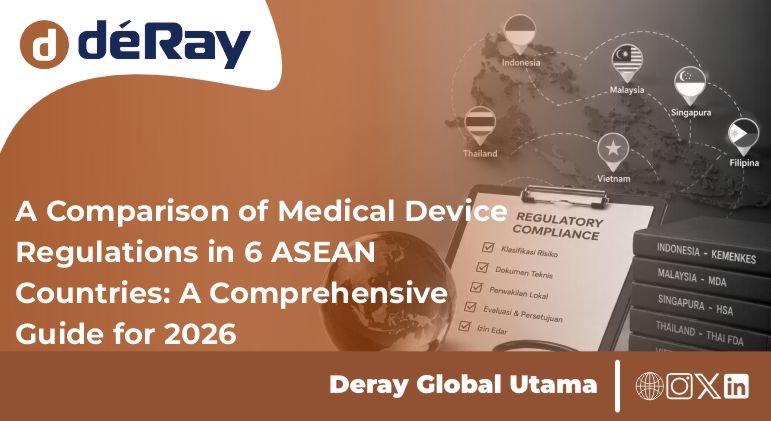
Indonesia - Kemenkes
Governed under Permenkes 11/2025, with risk classification from Class A to D. The Izin Edar is tied to the license holder, and foreign manufacturers without a local entity must appoint a Local Authorized Representative holding CDAKB certification.
Malaysia - MDA (Medical Device Authority)
The MDA manages medical device registration through the MeDC@St system, with risk classification also following a Class A to D approach. Malaysia is one of the most active countries in the region in building mutual recognition arrangements, including the now permanent Reliance Programme with Thailand.
Singapore - HSA (Health Sciences Authority)
The HSA is known for a relatively efficient evaluation process and is often the first reference point for global manufacturers entering Southeast Asia. For software as a medical device (SaMD), HSA's approach is function and intended-use based, in line with the principle also adopted by the FDA.
Thailand - Thai FDA
The Thai FDA regulates medical device registration under its own risk classification system, and is now linked to Malaysia through the Reliance Programme, permanent since May 2026, allowing partial recognition of evaluations already completed in the partner country.
Vietnam - DMEC (Department of Medical Equipment and Construction)
Medical device registration in Vietnam involves a risk classification process and technical documentation requirements with their own distinct characteristics, often regarded by foreign manufacturers as one of the more document heavy processes in the region.
Philippines - Philippine FDA
The Philippine FDA runs a risk-based registration process similar to other ASEAN countries, but with administrative requirements and timelines that carry their own local characteristics.
| Negara |
Regulator |
Syarat perwakilan lokal |
| Indonesia |
Kemenkes |
Mandatory (LAR + CDAKB) |
| Malaysia |
MDA |
Mandatory for non-local entities |
| Singapore |
HSA |
Mandatory for non-local entities |
| Thailand |
Thai FDA |
Mandatory for non-local entities |
| Vietnam |
DMEC |
Mandatory for non-local entities |
| Philippine |
Philippine FDA |
Mandatory for non-local entities |
What is consistent across all six countries
All six countries require a legally registered local representative for manufacturers without a local entity. What differs is in the details: required technical documents, evaluation timelines, and how far mutual recognition between countries has actually progressed.
Where ASEAN harmonization is heading
The Malaysia-Thailand Reliance Programme is the most concrete form of cooperation so far, but it remains bilateral. The ASEAN Medical Device Directive provides a shared framework, but implementation is still left to each country. Manufacturers hoping one dossier will work across the whole region should, based on what we have observed, expect to wait a while longer.
Strategy for sequencing ASEAN market entry
We usually advise clients to start with the market they understand best or find most strategically important, then expand based on the next country's regulatory complexity, rather than assuming progress in one country will speed things up in another.
Conclusion
Medical device regulation across ASEAN remains fragmented even as the long-term direction points toward harmonization. For manufacturers building a regional strategy, understanding the differences across these six frameworks is the first step before mapping out a realistic market entry sequence.
If you are building an ASEAN market entry strategy, we can help think through where to start. Reach us at info@derayglobalutama.com.




 English
  Indonesian